THE PERSON LISTENING
Some truths become easier to tell when you know the person listening won’t need you to defend them first.
I’m Philip.
If you're here because you're trying to decide whether I might be someone you could actually talk to, I think you deserve more than a list of credentials.
My training matters. My experience matters. But neither tells you everything about what it might feel like to sit across from me and bring in something complicated, tender, messy, uncomfortable, or difficult to say out loud.
So I want to start somewhere more human.
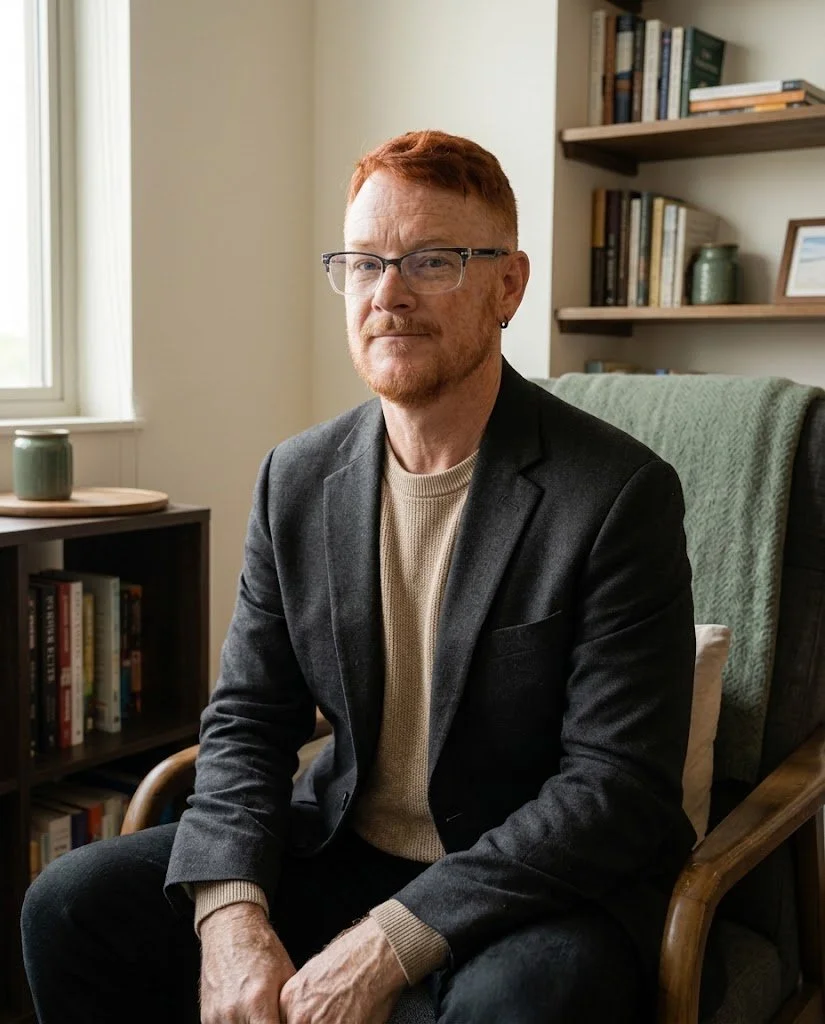
Philip A. Bower, LICSW
Therapist • U.S. Navy Veteran • Author
There are parts of your life I may recognize because of my own. There are systems, identities, losses, relationships, and ways of surviving that may not require quite as much explanation here.
But recognition is not the same thing as knowing.
My experience should make less work for you—not give me permission to make assumptions about your life.
That distinction matters to me.
I want familiarity to help us get closer to the real conversation—not convince either of us that I already know your story.
So before I tell you what I do, I want to tell you a little about what shaped the way I listen.
The rooms that shaped me ↓
THE ROOMS THAT SHAPED ME
I learned early that honesty and safety are not always the same thing.
I served in the United States Navy from 1992 to 1993.
I was discharged one day before Don't Ask, Don't Tell went into effect.
That distinction matters.
My experience wasn't one of serving under DADT. It came at the edge of a policy change, during a period when being gay could still determine whether someone was permitted to serve.
I was proud to serve. I also learned what it meant to belong to an institution while knowing that honesty about something central to who I was could carry very real consequences.
When something central to who you are has to be carefully managed, you become good at reading rooms.
You notice what is safe to say.
You notice who is listening.
You learn when to reveal something, when to soften it, and when silence feels safer than being fully known.
Those kinds of adaptations don't appear out of nowhere.
They are often intelligent responses to the environments that required them.
My military story is one part of my life. It isn't a template I place over anyone else's.
But it helped teach me something I still carry into therapy:
Before deciding that a response is irrational, excessive, resistant, or broken, I want to understand what made that response make sense.
Sometimes what looks like guardedness makes much more sense when you understand what happened when someone stopped guarding themselves.

WHAT THAT TAUGHT ME
Context changes the question.
Therapy can become very different when we stop asking only:
“What is wrong with you?”
and become curious about:
“What happened around you—and what did you learn you needed to do to survive it?”
That shift doesn't excuse everything.
It doesn't mean every pattern remains useful forever.
It gives us context.
Something can have protected you once and still be costing you something now.
Hypervigilance may have helped you notice danger before anyone else did.
Guardedness may have helped you decide who had earned access to you.
Perfectionism may have helped you avoid criticism.
Emotional distance may have helped you survive relationships or environments where vulnerability wasn't safe.
Understanding why something developed doesn't require us to pretend it still works.
It gives us a more compassionate place from which to decide what you want to keep, what you want to change, and what you may finally be ready to put down.
You are not a diagnosis happening in isolation.
You are a person who has been living somewhere, among people, inside systems, carrying a history.
I want there to be room for all of that here.
You don't need to be a veteran—or have lived through anything resembling my story—for this way of understanding adaptation to matter.
Different environments teach different survival lessons.
The military was one environment that shaped me.
It wasn't the only place I learned that the scripts we're handed don't always leave room for the lives we're actually living.
Beyond the usual scripts ↓
BEYOND THE USUAL SCRIPTS
My life hasn’t always followed the usual scripts either.
There are plenty of messages about what a life is supposed to look like.
Who we should love. How relationships should work. What commitment is supposed to mean. Which identities are understandable. Which kinds of intimacy are acceptable. When we should have ourselves figured out.
Real lives tend to be more complicated than that.
Mine has been too.
I'm a gay man, and my own life includes experience with consensual non-monogamy.
I don't share that because I think having something in common automatically makes me the right therapist for you.
I share it because sometimes knowing you won't have to begin with “Let me explain why my life works this way” makes it easier to get to the conversation you actually came to therapy to have.
Shared experience can reduce the burden of translation. It cannot replace curiosity.
Your relationships are yours. Your identity is yours. Your values are yours.
Even when something about your life sounds familiar to me, I still need to learn what it means to you.
Two gay men can have profoundly different relationships with being gay.
Two veterans can carry completely different meanings from their service.
Two people practicing consensual non-monogamy can have entirely different agreements, values, boundaries, joys, and struggles.
Familiarity gives us vocabulary. It doesn't give me your answers.
In therapy, I don't begin with the assumption that a relationship is healthy because it's conventional—or unhealthy because it isn't.
I'm more interested in what is actually happening between the people involved.
Is there consent?
Is there honesty?
Is there room for boundaries?
Can needs be named?
What happens when agreements aren't working?
What happens after someone gets hurt?
Is there space for each person to remain a whole person while being connected to someone else?
Conventional and healthy are not synonyms.
Neither are unconventional and healthy.
What matters is what is actually happening in your life.
DIFFERENT ISN’T THE SAME AS BROKEN
You shouldn’t have to spend therapy defending the shape of your life.
If your identity, relationships, sexuality, community, or way of building a life sits outside somebody else's idea of “normal,” therapy shouldn't automatically become another room where you're asked to make yourself more understandable.
But affirming care is not the same thing as unquestioning approval.
I don't think my job is to automatically celebrate everything simply because it falls outside a conventional script.
My job is to understand your life accurately enough that we can look honestly at what is helping, what is hurting, what belongs to you, and what may have been handed to you by somebody else.

Sometimes the work is about communication, jealousy, grief, attachment, shame, boundaries, sex, trust, rupture, loneliness, or change.
Sometimes it's about navigating agreements that no longer fit.
Sometimes it's about figuring out what you actually want rather than what you were taught you were supposed to want.
And sometimes it's the exhaustion of living in environments where people keep treating your life like a debate.
We can start with what is actually happening.
Having something in common can make a room feel more familiar.
But familiarity is only useful if it leaves enough room for me to discover who you are.
That is the kind of familiarity I want to offer: enough shared vocabulary to reduce unnecessary explanation, with enough curiosity that your story never gets mistaken for mine.
Because the real question isn't whether we have something in common.
It's what I do with that familiarity once we're sitting together.
What that means for you ↓
WHAT THAT MEANS FOR YOU
Familiarity should make less work for you, not create assumptions about you.
There may be things you don't have to explain from the beginning with me.
I probably don't need a primer on why coming out can be complicated, why chosen family can matter, why military culture can stay with you long after service, or why consensual non-monogamy isn't simply another word for infidelity.
That kind of familiarity can save us time.
But it should never become a shortcut around knowing you.
If you tell me you're gay, I still need to understand what being gay means in your life.
If you're a veteran, I still need to understand your relationship with your service.
If you're polyamorous, kinky, monogamous, single, partnered, or somewhere between labels, I still need to understand how your relationships work.
If you've survived something traumatic, I don't want trauma to become the explanation for everything about you.
Cultural literacy should open the conversation. It shouldn't finish it for us.
I want enough familiarity to reduce unnecessary explanation—and enough humility to keep asking who you are.
I’ll ask rather than assume.
Shared language can help us begin. Your meaning still matters more than my familiarity.
I’ll be willing to name things.
Affirming therapy doesn't mean avoiding difficult conversations when something may need our attention.
I’ll respect context.
What happened around you belongs in the conversation alongside what is happening inside you.
You remain the author.
I can offer perspective, questions, challenge, and support. Your life still belongs to you.

WHAT AFFIRMATION MEANS TO ME
Affirming doesn't mean agreeing with everything.
I want you to know that your identity, relationships, sexuality, history, and way of making a life do not need to be defended before we can work together.
But I also don't think affirmation means pretending everything in someone's life is automatically working simply because it is authentic to them.
We can respect who you are and look honestly at what hurts.
We can affirm a relationship structure and talk about whether something happening inside that relationship feels harmful.
We can understand why a survival strategy developed and notice when it is making your life smaller now.
We can respect your autonomy and have moments when I offer a perspective you may not agree with.
Who I am influences the way I practice.
But lived experience isn't enough.
You also deserve to know whether the person sitting across from you has the clinical grounding to do this work well.
The professional part matters too ↓
THE PROFESSIONAL PART MATTERS TOO
Humanity matters to me. So does good clinical work.
Being able to relate to someone is not the same thing as being equipped to help them.
My work is grounded in assessment, collaborative treatment planning, evidence-informed psychotherapy, ongoing attention to safety and risk, and something equally important: paying attention to whether what we're doing is actually helping.
I don't believe a therapist's warmth should be used as a substitute for competence.
You deserve both.
Depending on what we are working with, I may draw from approaches including ACT, CBT, DBT-informed skills, motivational interviewing, mindfulness, self-compassion, trauma-informed care, and polyvagal-informed work.
I don't believe in forcing a person into a modality simply because it is the tool I know best.
The framework should serve the person—not the other way around.

My clinical experience has included outpatient therapy, hospital-based behavioral health, crisis-oriented work, clinical supervision, and telehealth.
Those settings have reinforced something I keep returning to:
people make more sense when we understand the context around what they are carrying.
That is one reason I pay attention not only to symptoms, but also to relationships, systems, culture, identity, loss, history, environment, and the roles a person has had to occupy.
THE CREDENTIALS BEHIND THE WORK
Licensure
Massachusetts
Licensed Independent Clinical Social Worker
Maine
Licensed Clinical Social Worker
Washington
Licensed Independent Clinical Social Worker
Professional Perspective
U.S. Navy Veteran
Psychotherapist
Author
Clinical Supervisor
Education
Master of Social Work
Walden University
Bachelor of Arts, Psychology
American Public University
I’m also the author of The Threshold Reset Workbook and have contributed to teaching and professional education.
Writing and teaching give me other ways to explore the same question that sits underneath much of my therapy work:
What helps people become more fully themselves without requiring them to erase the adaptations that once helped them survive?
Credentials can tell you that I have training.
They can tell you that I have been licensed to practice.
They can tell you something about the settings where I have worked and the approaches I may use.
They still can't tell you what fifty minutes with me will actually feel like.
So now that you know something about the person I am and the clinician I have trained to become, I want to tell you something more practical:
What I’m like in the room ↓
WHAT YOU CAN EXPECT FROM ME
I’m warm, but I’m not interested in pretending everything is fine when it isn’t.
I’m affirming, but that doesn’t mean I will agree with everything you say.
I’m curious, and I’ll ask questions when I think there may be something underneath the story we’re telling.
I’m comfortable with humor, silence, directness, emotion, and conversations that don’t fit neatly into the hour.
What I’m like in the room.
I may help you slow something down.
I may ask what happens in your body when you say a particular thing.
I may notice when the way you talk about yourself sounds harsher than the way you would talk about anyone else.
I may ask whether a familiar pattern is still protecting you—or whether it is mostly exhausting you now.
And sometimes I may simply stay with you in something that does not need to be solved before it can be witnessed.

I don’t want therapy to feel like a performance review.
I want it to be somewhere we can tell the truth about what is happening and work with it together.
What I won’t promise.
I won’t promise that therapy will always feel comfortable.
I won’t promise to have the right interpretation every time.
I won’t pretend that sharing an identity means I automatically understand your version of it.
And I won’t promise a version of healing where nothing difficult ever happens again.
What I can promise is that I’ll take the work seriously and keep paying attention with you.
I also believe there are times when being useful means being willing to say something clearly.
If I notice a pattern, I may name it.
If something doesn’t seem to fit together, I may ask about the contradiction.
If I think we’re circling something important, I may invite us to stay with it a little longer.
Directness, to me, is not the opposite of compassion. Sometimes it is part of it.
Therapy can also contain humor.
Not because everything is funny, and never to move past something that hurts.
But because sometimes laughter is connection. Sometimes it is relief. Sometimes it helps us notice the absurdity of something without minimizing its impact.
I don’t believe I need to become a blank wall in order to be your therapist.
I want to be present enough that you know there is another human being in the room with you.
If we work together, I want you to experience both:
enough safety to be honest
and
enough honesty for the work to matter.
I don’t think we have to choose between the two.
You know much more now about who I am, what shaped me, how I think about therapy, and what I may be like to sit with.
There is one thing I don’t want any of that to take away from you:
your right to decide whether I feel like the right person for this part of your story.
You still get to decide ↓
KNOWING MORE DOESN’T OBLIGATE YOU
You still get to decide.
Maybe something on this page made you think, “Yes. He might understand.”
Maybe something made you curious.
Maybe you're still unsure.
All three are reasonable places to be.
You don't owe me a session because you read this far. You don't need to convince yourself that I'm the right therapist because parts of my story sound familiar.
Fit matters. Your sense of safety matters. And your choice matters.
You don't have to decide from this page.
If you want to understand more about the work before deciding anything, keep exploring.
You can look at the areas I most often work with, see the different ways you can access care, or simply request a conversation and ask the questions that matter to you.
CHOOSE WHAT YOU NEED NEXT

Start with what you’re carrying.
If you're still trying to understand whether my work fits what you're experiencing, this is a good next place to go.
See how we could work together.
Compare direct pay, insurance pathways, where I practice, scheduling, privacy differences, and what to expect.
Ready to have a conversation?
You don't need to know exactly what you want from therapy before reaching out. We can begin with a conversation about what brings you here and whether working together makes sense.
Whichever direction you choose—even if that direction is simply closing this page and thinking about it for a while—I hope you've learned enough here to make that choice with a little more clarity.
Therapy asks for enough vulnerability already. Choosing a therapist shouldn't require giving up your agency before you've even begun.
Philip A. Bower, LICSW
Authentic Arch Counseling
Virtual therapy in Massachusetts, Maine & Washington